
Quick Facts
Home Type: 1963 Split-Level Home, 1,842 sq ft
Main Problems: Air leakage, outdated HVAC equipment, drafty attic and crawlspace areas
Solutions: Attic insulation, kneewall and crawlspace air sealing, vapor barrier installation, boiler and AC upgrades
Results: 31% projected annual energy savings, $6,000 rebate, improved comfort, and significant reduction in air leakage.
Project Duration: Mechanical upgrades 3 days and Insulation upgrades 2 days for total of 5 day project
Homeowner Goals: Eliminate drafts, improve temperature consistency, replace aging mechanical equipment, and reduce energy costs.
The Homeowner’s Concerns
When the homeowners of this 1963 split-level home in Medford, NJ began researching options for replacing their aging boiler and air conditioning system, they wanted more than just new equipment. Like many older split-level homes, they were experiencing uneven temperatures, drafts, and energy loss that made maintaining comfort throughout the house increasingly difficult.
During the initial consultation, B&E Energy Solutions performed a comprehensive whole-home evaluation through the PSEG Whole Home Energy Solutions Program. Rather than simply replacing HVAC equipment, the assessment focused on how the building envelope and mechanical systems work together.
Energy modeling projected approximately 31% annual energy savings, allowing the homeowners to qualify for valuable rebates and 0% financing. Based on the findings, they chose a complete home performance approach that included attic and crawlspace improvements along with high-efficiency heating and cooling upgrades to improve comfort, efficiency, and long-term reliability.
What Our Testing Revealed
Like many split-level homes built during the 1960s, this house had several hidden sources of energy loss contributing to uncomfortable rooms and uneven temperatures.
Testing and visual inspection revealed significant air leakage through the attic and kneewall areas, allowing conditioned air to escape into unconditioned spaces. These leakage pathways are common in split-level homes and often contribute to rooms that are difficult to keep comfortable throughout the year.
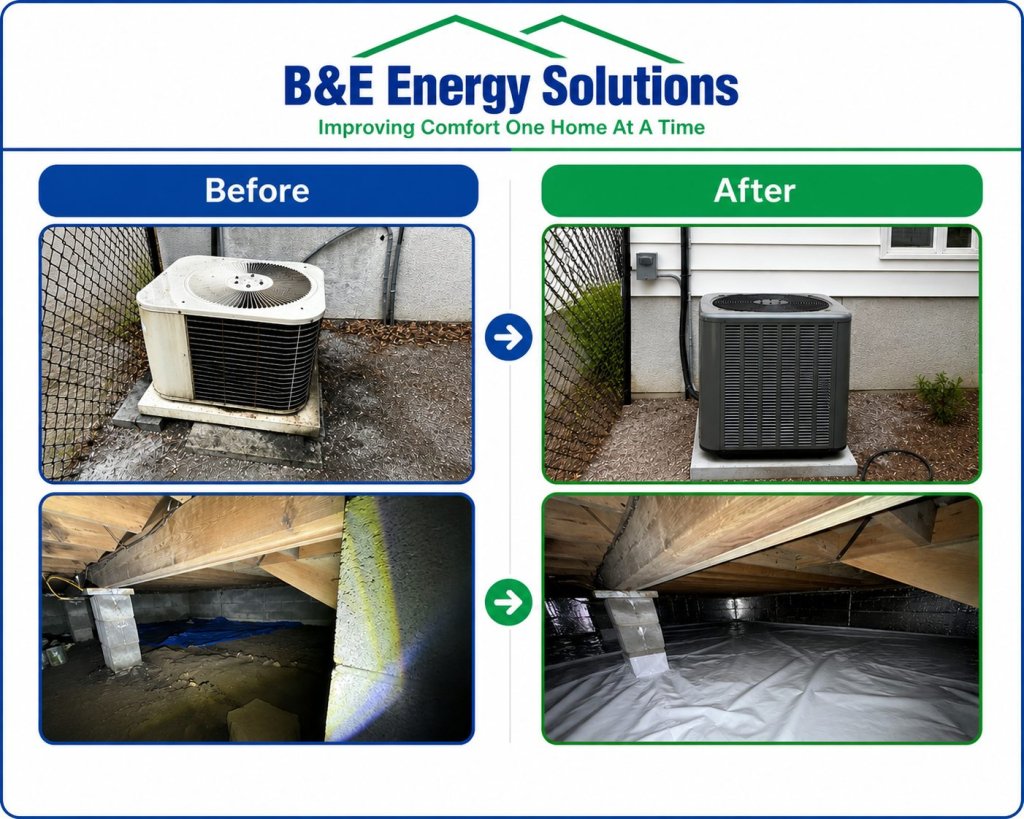
The crawlspace also required attention. Exposed rim joists and foundation areas allowed outside air to infiltrate the home, while exposed soil increased the potential for moisture and humidity issues. Because the crawlspace would become part of the home’s thermal boundary, controlling ground moisture with a vapor barrier was an important part of the overall strategy.
The existing boiler had reached the end of its expected service life, and the aging air conditioning system no longer met modern efficiency standards. Since conditioned air was escaping through the building envelope, the HVAC equipment had to work harder to maintain indoor comfort, increasing energy consumption and reducing overall performance.
Instead of replacing equipment alone, the homeowners chose a whole-home solution designed to address the underlying causes of their comfort issues while improving efficiency and reducing long-term operating costs.
Why These Improvements Were Recommended
Blower Door Test: 3,750 CFM50
Projected Energy Savings: 31%
Primary Concerns: Drafts, air leakage, aging HVAC equipment, crawlspace moisture concerns, uneven temperatures between levels.
Blower door testing measured 3,750 CFM50, indicating moderate air leakage throughout the home. Much of this leakage was occurring through the attic, kneewall areas, crawlspace, and other transition spaces common in split-level homes. These conditions forced the heating and cooling equipment to work harder and contributed to inconsistent indoor temperatures.
Attic and Kneewall Upgrades
Blower door testing helped identify leakage pathways between the conditioned living space and unconditioned attic areas. These bypasses allowed heated and cooled air to escape and contributed to temperature differences between levels of the home.
Air sealing was completed before adding insulation to reduce stack-effect air movement and improve the effectiveness of the insulation system. Blown-in cellulose insulation was installed to increase attic R-values and reduce heat transfer. T he kneewall areas, which are common trouble spots in split-level homes, were upgraded with rigid foam board insulation to create a more continuous thermal boundary. The attic hatch and access openings were also sealed to minimize unwanted airflow.
Together, these improvements help maintain more stable indoor temperatures while reducing the workload placed on the heating and cooling equipment.
Crawlspace Encapsulation
The crawlspace walls and rim joists were air sealed and insulated to reduce drafts and prevent outside air from affecting the lower levels of the home.
Since the crawlspace became part of the home’s conditioned envelope, exposed soil needed to be addressed as well. A heavy-duty vapor barrier was installed to control ground moisture and help protect the home from humidity-related issues that can impact comfort, indoor air quality, and the long-term durability of insulation materials.
By encapsulating the crawlspace and improving the building envelope, the lower levels of the home became more comfortable while helping the entire house perform more efficiently.
Ventilation Corrections
Bathroom exhaust improvements and dryer vent corrections were completed to promote proper airflow and reduce excess moisture buildup inside the home. Proper ventilation is an important component of home performance, helping maintain indoor air quality while supporting the effectiveness of insulation and air sealing upgrades.
Heating and Cooling System Upgrades
Once the building envelope improvements were addressed, the heating and cooling systems were upgraded by Accurately Controlled Environments (ACE) to provide reliable and efficient comfort throughout the home.
The old boiler was replaced with a high-efficiency 95% AFUE system, significantly improving heating performance while reducing fuel consumption. A new 15.2 SEER2 air conditioning system with an EER2 rating of 12.5 was also installed to provide more efficient cooling during the summer months.
An indirect water heater was added as part of the boiler upgrade, allowing domestic hot water to benefit from the efficiency and reliability of the new heating system.
Blower Door Test Results
Post-installation blower door testing showed airflow leakage had been reduced from 3,750 CFM50 to 2,850 CFM50, representing a reduction of approximately 24%.
By addressing attic leakage, improving kneewall insulation, and incorporating the crawlspace into the home’s thermal boundary, the house now retains conditioned air much more effectively.
Split-level homes often experience temperature differences between floors due to multiple transition spaces and hidden leakage pathways. These improvements help create more consistent temperatures throughout the home while reducing drafts and improving overall comfort.
With less conditioned air escaping, the new heating and cooling systems can operate more efficiently, reducing energy usage and helping lower utility costs.
Rebates and Financing
The total project investment was $38,007. Through the PSEG Whole Home Energy Solutions Program, the homeowners qualified for a $6,000 rebate, helping reduce the overall project cost.
To further minimize the upfront expense, the project also qualified for $25,000 in 0% financing through the homeowner’s PSEG utility bill. Spread over 10 years, the monthly payment is approximately $209, making it easier to invest in long-term comfort and energy efficiency improvements without a significant initial financial burden.
Energy modeling projected approximately 31% annual energy savings, helping offset heating and cooling costs while providing long-term value. By combining rebates, financing, and lower operating costs, the homeowners were able to make comprehensive improvements that may have otherwise been delayed or completed in phases.
By addressing the home as a complete system, the homeowners were able to complete both the HVAC replacement and weatherization improvements at the same time rather than piecing the project together over several years.
Life After the Improvements
By taking a whole-home approach, these improvements addressed the root causes of energy loss instead of simply replacing HVAC equipment. With the attic, kneewalls, and crawlspace properly air sealed and insulated, the home now retains conditioned air much more effectively, helping create a more comfortable and energy-efficient living environment, durable, and energy-efficient home.
Older split-level homes often experience uneven temperatures, drafty rooms, and comfort issues caused by hidden air leakage between conditioned and unconditioned spaces. By improving the building envelope and upgrading the heating and cooling systems, the homeowners can now enjoy more consistent comfort throughout the year while reducing the workload on their HVAC equipment.
Additional everyday benefits include:
- More consistent temperatures between floors and from room to room.
- Fewer drafts and cold spots during the winter months.
- Improved cooling performance and humidity control during the summer.
- Reduced strain on the heating and cooling equipment, helping support long-term reliability.
- Better moisture control in the crawlspace and lower levels of the home.
- Improved indoor comfort throughout New Jersey’s changing seasons.
- Lower monthly utility costs through improved energy efficiency.
- Greater peace of mind knowing the home is more durable
,and better protected against moisture-related issues.
Together, these upgrades provide year-round comfort, improved efficiency, and long-term value while helping the home perform as a complete system.
Project Summary
This project highlights the benefits of taking a whole-home approach to comfort and energy efficiency. Rather than simply replacing aging HVAC equipment, the homeowners addressed the underlying causes of energy loss by combining air sealing, insulation upgrades, crawlspace encapsulation, and high-efficiency mechanical systems.
The result is a more comfortable, durable, and energy-efficient home that is better equipped to maintain consistent temperatures throughout the year.
Through the PSEG Whole Home Energy Solutions Program, the homeowners qualified for a $6,000 rebate and $25,000 in 0% financing, making it easier to invest in improvements that will continue providing benefits for years to come.