Quick Facts
- Home Type: 1956 Bi-Level, 2,244 sq ft
- Main Problems: Drafts, insulation gaps, uneven temperatures, aging HVAC equipment
- Solutions: Added attic and kneewall insulation, sealed air leaks, upgraded furnace, AC, and water heater
- Results: $5,800 rebate, $0 out-of-pocket cost, better comfort and efficiency
- Project Duration: HVAC/DHW was install in 1 day and WX in 1 day = 2 days.
Overview
This bi-level home in Little Silver was built in the 1950s and, like many older homes, had not received the insulation or efficiency upgrades needed to keep energy costs under control. The homeowner reached out through the NJNG Audit Program looking for a full home upgrade, including insulation, air sealing, and mechanical replacement.
During the consultation, we explained how improvements to insulation and HVAC equipment could significantly enhance comfort while taking advantage of NJNG rebates and a 0% loan to eliminate upfront costs. As part of the audit process, we modeled the home’s projected energy performance to determine expected savings and rebate eligibility. The modeling showed an annual 24% estimated total energy savings, qualifying the home for strong incentives through the program.
After reviewing the available options, the homeowner chose to move forward with a complete weatherization project that included attic improvements, kneewall insulation, air sealing, new high-efficiency HVAC equipment and power vented water heater.
Before the Work
Before the weatherization team arrived, our audit team inspected the home and documented several areas where energy loss was occurring. Insulation levels in the attic and kneewall spaces were inadequate, and the pulldown attic stairs were uninsulated and unsealed—one of the most common sources of heat loss in homes.
Recessed lights and attic transitions were leaking air directly into the attic. Bathroom exhaust ventilation needed correction, and the dryer vent required improvements as well.
The home’s furnace, air conditioner, and water heater were older and operating at lower efficiency levels compared to modern equipment. Combined with a leaky building shell, they had to run longer and harder to maintain indoor comfort.
Testing and Initial Data
A blower-door test showed that the home had significant air leakage. The home measured 4,890 CFM50, indicating notable airflow through the attic, kneewalls, and other transitions typical in mid-century bi-level designs.
During the assessment, we modeled the home’s projected energy savings to determine rebate eligibility. Based on this modeling, the project was estimated to save 24% in total annual energy use, qualifying the homeowner for the NJNG rebate and a 0% loan.
The goal of the work was to reduce air leakage through attic and kneewall improvements and to bring the mechanical equipment up to modern efficiency standards—steps that would drive meaningful comfort improvements and reduce energy use long-term.
What We Did
Over the course of the project, the team completed a full weatherization and mechanical upgrade.
Attic & Kneewall Work
We air-sealed and insulated the attic using blown-in fiberglass, improving overall R-value and reducing heat loss through the upper floors.
Kneewalls were air-sealed and insulated with foam board, an important step in bi-level homes where these side spaces often allow heat to escape.
Pulldown stairs were sealed and insulated with custom made foam box cover and weatherstriped, and multiple recessed lights were properly air-sealed with tenmat covers to address major leakage pathways while protecting the light fixtures.
Ventilation & Dryer Corrections
Bathroom exhaust ventilation and the dryer vent were corrected to improve both safety and air quality.
Proper venting helps reduce moisture buildup and protects the home’s structure.
HVAC and Hot Water Systems
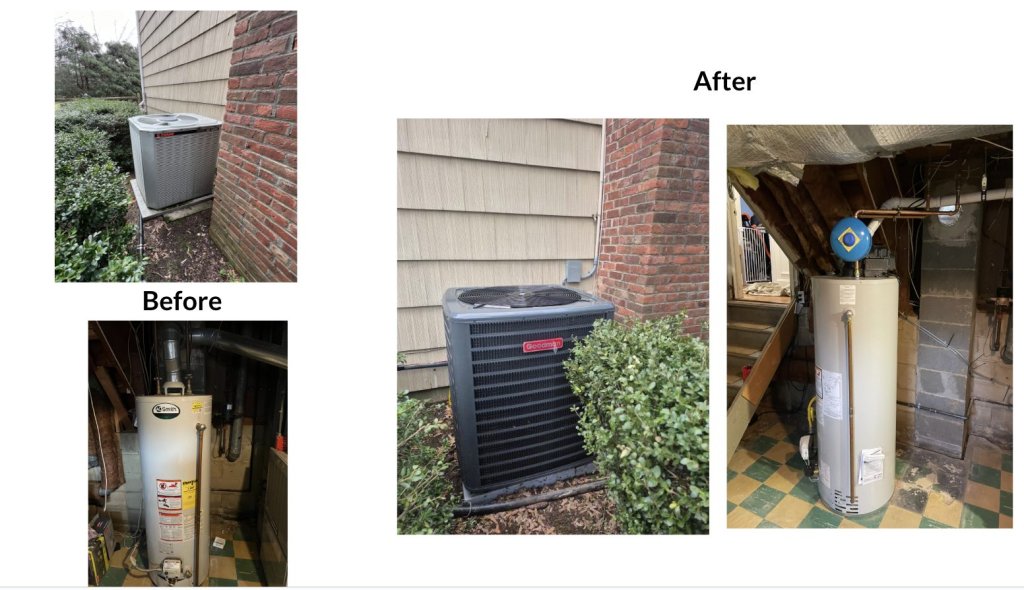
The older equipment was replaced prior to weatherization with new, high-efficiency systems.
The furnace now operates at 96.1% AFUE, converting nearly all fuel into usable heat.
The air conditioner was upgraded to 15.2 SEER2 with an EER2 of 12.50, improving cooling efficiency.
A new power-vented water heater with a UEF of 0.72 and dedicated PVC venting was installed to replace the older naturally vented unit. As homes are air-sealed and insulated, they become much tighter, which can interfere with how naturally vented water heaters exhaust combustion gases.
Upgrading to a power-vented system ensures the water heater vents safely and reliably, preventing back-drafting and reducing potential indoor air quality and safety concerns in a tighter, more efficient home.
Results and Testing After the Work
A follow-up blower-door test showed improvement, with airflow dropping from 4,890 CFM50 to 4,500 CFM50, a reduction of 390 CFM. Bi-level homes are known to be especially drafty due to how the walls and floors connect between levels, creating multiple pathways for air to move freely through the structure. While these leakage points cannot always be fully eliminated, sealing key areas such as kneewalls, pulldown stairs, and recessed lights significantly reduced unwanted airflow and improved overall comfort.
A tighter home keeps warm air inside during winter and cool air inside during summer, helping the HVAC system run less often and use less energy. This leads to lower monthly utility bills, more stable indoor temperatures, and a more comfortable living environment year-round.
Financial Impact
The total project cost was $19,750, but the homeowner qualified for a $5,800 rebate and financed the remaining balance through a $13,950 NJNG 0% loan.
With the rebate and loan options, the homeowner paid $0 out of pocket at the time of installation.
Energy modeling projected 24% annual total energy savings, resulting in lower heating and cooling costs throughout the year.
Comfort and Everyday Benefits
The upgrades produced a notable improvement in comfort. Areas of the home that previously felt drafty now maintain temperature more effectively. The upper level in particular benefits from sealed kneewalls and improved attic insulation.
Moisture control is better thanks to corrected exhaust ventilation, and the home feels quieter and more stable overall. The new HVAC system runs more efficiently and evenly, providing improved airflow and reducing hot and cold spots.
Summary
This project demonstrates how a combination of insulation, air sealing, and efficient mechanical upgrades can dramatically improve the comfort and performance of a mid-century bi-level home.
With no upfront cost through the NJNG Program, the homeowner was able to transform their home into a more comfortable, efficient, and healthy living environment—all while reducing annual energy use.
Terms to Know
- ACH50: (Air Changes per Hour at 50 Pascals) measures a building’s airtightness by how many times its total air volume is replaced in an hour under a 50 Pascal pressure difference
- AFUE: a percentage rating for furnaces and boilers showing how much fuel is converted into usable heat
- Annual energy savings: the money and energy conserved by improving efficiency, often achieved through upgrades
- Blower Door Test: A diagnostic tool that measures the overall air leakage of a home
- CFM50: A measure of how leaky a house is under test pressure
- EER2: A modern efficiency rating that measures how effectively an air conditioner cools
- SEER2: A seasonal efficiency rating similar to MPG for cooling systems
- Tenmat: A Tenmat recessed light cover is a fire-resistant, non-combustible enclosure, typically made from mineral wool, designed to fit over recessed (can) lights in an attic to create a safe barrier, allowing insulation to be piled over them without fire risk, while also sealing air leaks for energy efficiency. These covers are essential for non-IC (Insulation Contact) rated fixtures, stopping heat loss and preventing flames/heat from spreading through the ceiling assembly during a fire, with some offering 1- or 2-hour fire ratings.
- UEF: Uniform Energy Factor for water heaters (a higher number means greater efficiency)